For anyone this is interested in reading my final submission, here is the link.
You can also find it by clicking the menu.
Let me know what you think.
For anyone this is interested in reading my final submission, here is the link.
You can also find it by clicking the menu.
Let me know what you think.
When this class started, I did not realize how much writing would be required. It is funny that I feel that way with most of my classes. I tend to underestimate exactly how much writing I need to budget time to complete assignments. This is important because I not only attend UC full time, but I also work full time and lead a very busy family life with 3 high school sophomores and 1 college freshman.
Having said all that, I have enjoyed this class. It has taught me a lot about the different aspects of writing and how to incorporate it with my career. My focus in earning my bachelors degree is to move into a management position with my current employer, and possibly pursue my Masters in Healthcare Administration. I have been very lucky that I have supportive management and they are always willing to lend their knowledge to me to help me complete my assignments.
For the Personalized Learning Plan assignment, I planned out my time to complete each part but then I found myself getting stuck on each example of writing that was needed. I just let my head get to me and derail some of my timeline. I was able to overcome this thankfully and I am pretty happy with the result. One of the things that I found hard was the writing we do at work is pretty much the same, and does not lend itself well to a diverse PLP.
I have used WordPress for the past couple semesters. I have always found it difficult to maneuver. I’m sure if I had more time it would be easier for me to navigate. My original portfolio for this class was very simple, just a black background with white font. When we were asked to change the design of our portfolios, I chose Circa. It is much lighter, with a cream background and springy, green and pink details. I also like the how the layout looks against the background.
Working in pharmacy, I did not feel like I needed to add pictures to my portfolio, nothing was really relevant.
Genre, audience, rhetorical situation, and discourse community. These were all foreign terms to be before beginning this course. Of course, I knew the words, but not how they relate to communication.
Rhetorical situation was probably the one concept that was most strange. But when you break it down to writer, audience, message, and purpose. It seems very easy from that point on.
Discourse community is another interesting concept. We all belong to so many of them and do not even realize it.
Over all, learning about these different terms, has helped me in my daily communications, both at home and at work.
Most of our patients are associates so they tend to understand medical terminology. However, each subgroup or discourse community in our hospital network has its own terms that are used daily that may be unfamiliar to others in a different department.
Working in specialty pharmacy, it is like a foreign world to most people. We have our own lexis we use that we have to explain often. One example is PA, which means prior authorization, which also means approval from an insurance company to cover the cost of a medication.
We also use multiple genres in communicating with each other. For a quick question, we might just walk over to someone at their desk. We might also send them a Teams message or email. If we want to explain something in more detail, we might call them on the phone. While none of these are unique to healthcare, we are able to tailor them to work for us very effectively.
Discourse communities are groups of people that share the same interest or goal in life. They may also share a common language.
I can identify with this as a healthcare worker. In pharmacy, we use specialized terms that someone from the outside might not understand. Common goals for my career would be helping patients obtain their medications.
I’ve also been a Boy Scout leader for the last 13 years, and we use terms specific to Scouting. While common goals in Scouting is helping youth learn through their Scouting experiences.
We are all also part of a discourse community as college students. Even within this group we are broken down farther by our area of study for our degrees. We have some common terms and others that only someone in our specific program would understand.
Learning is something that never ends. There is always information we do not have, and if we are lucky we enjoy learning new things. There are many ways of learning. Some learn best through reading, others take notes and rewrite them repeatedly, and there are also those that learn best through hands-on activities.
A novice may have no or little knowledge. While an expert is someone that has studied a subject extensively. Depending on the subject matter it will take each learner a different amount of time to progress between the two stages of novice and expert. There are two types of experts, adaptive and routine. Routine experts are good in their own setting but have difficulty when the setting changes. While the adaptive expert is able to use that knowledge across settings.
I would like to think I am more adaptive than routine. I never know what my job will entail from day to day. I am responsible for training all of our new hires. Being able to recognize how people learn differently helps me adapt each person’s training. I would consider myself an expert in training .
An area where I am still a novice would be in management skills. I am fortunate to have a mentor in my director at work. She has been very encouraging and helps me daily. Along with the classes I have been taking at the University of Cincinnati, I am slowly learning more and figuring out how to be an effective manager. I am also lucky to have recently been selected for a ‘future leaders training’ at work. It is a six month program to help me hone my management skills and place me in a better position to transition to a management role when my degree is finished.
Reflection is helpful in learning, if done effectively. Being able to look at yourself in an objective manner, you can list what your skills and knowledge are, as well as areas where you need to improve. This can be difficult for some people if they do not want admit their weaknesses. I can understand not wanting to list my weaknesses for others to see but this is the best way to learn from them and help correct them.
My first example is a paper I wrote for my Applied Professional Writing class. The audience was my professor, Maureen McDaniel. The genre was an essay. The purpose was to discuss the impact of social media on healthcare.
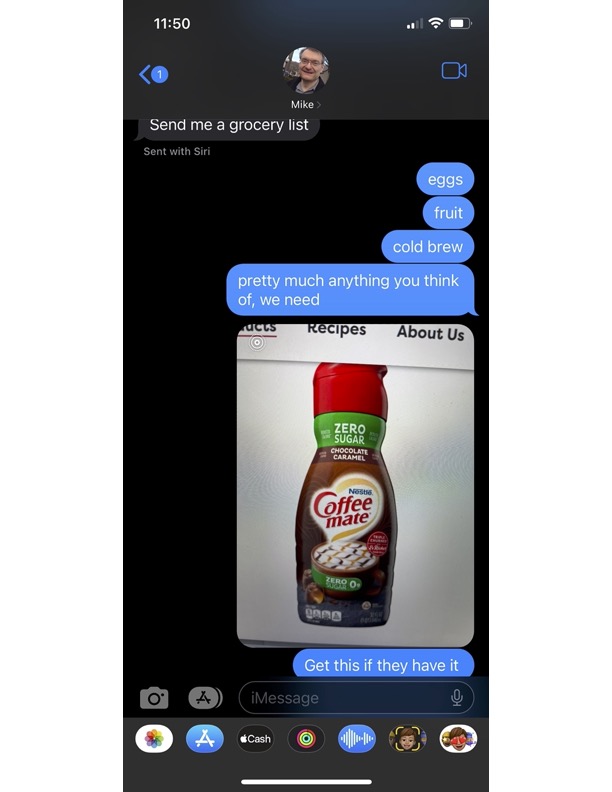
My second example is a text I sent to my husband. He is the audience. The genre is a text message. The purpose was to inform him of what to buy at the grocery store.
Rhetorical Situation is the circumstances that at least one person uses some type of communication to alter the perspective of at least one other person.
There are 4 main parts to a rhetorical situation:
As you compose your message, you must “consider not only how well it will match your readers’ knowledge, but also their needs, interests, values, and beliefs. Consider as well their reasons-or purposes-for reading what you’ll write.” (Palmquist)
An example would be me (writer) sending a letter (message) to a patient (audience) that I need them to send in financial documents (purpose) for medication foundation assistance.
Mike Palmquist. (1994-2023). Understanding Writing Situations. The WAC Clearinghouse. Colorado State University. Available at https://wac.colostate.edu/repository/resources/writing/guides/.
As we think of workplace communication, we need to consider three things:
who, what, and how.
Who are we communicating with?
What are we communicating?
How should we best phrase the conversation for that audience?
Keeping these three things in mind will help us to best compose our information we are conveying. Here is an example of tailoring a message to three different audiences and how they might be different.
If I am emailing a provider, I will want to be more formal and make sure to use proper medical terms.
If I am speaking on the phone with a patient, I need to speak in terms the patient will understand.
If I am messaging a coworker, I can be much more relaxed and informal.
These all convey the same message but are geared towards their respective audiences.
 Julie's Applied Professional Writing Blog